Blast mitigation coatings · Training · Business
Hold the wall.Build the business.
Spray-applied polyurea turns brittle walls, enclosures and vehicles into tough, fragment-catching shells. Learn where it is used, how it works, and how to build a business applying it, with training, equipment and UltraBlast™ polyurea from ArmorThane.
- No franchise fee or royalty
- Training at your location
- 24/7 tech support
- Up to 80%less standoff needed to stop catastrophic block-wall failure with about 1/8 in. of interior polyurea in AFRL proof-of-concept tests1
- 10×the peak pressure coated walls resisted without catastrophic collapse, compared with uncoated walls1
- 2,000 lbsaved per vehicle when the Navy's spray-on elastomer armor replaced equivalent steel add-on armor6
- $0franchise fees or royalties to become an ArmorThane applicator15
What blast mitigation coating does
Most blast injuries come from what the blast throws.
The U.S. DoD antiterrorism standard notes that injuries in building attacks come from "flying glass fragments and debris from walls, ceilings, and fixtures"5. A bonded elastomer on the protected face of a wall holds cracked masonry together, so the wall bends instead of shattering into the room.
That is the whole idea, and it is backed by more than two decades of military research. The Air Force Research Laboratory concluded that a thin elastomeric coating on the interior of a wall "can be effective at minimizing the deadly secondary fragmentation" of unreinforced block walls1.
Read the science- 01
Detonation
A shock front loads the wall in milliseconds. In AFRL's wall tests the positive pressure phase lasted only about 10 ms1.
- 02
Cracking
Masonry cracks at the mortar joints. Because the bond is so strong, the polymer strains mainly where those cracks open1.
- 03
Membrane action
The elastomer stretches without tearing, turning blast energy into strain energy instead of flying block2.
- 04
Containment
The cracked wall is held together and shields the room from debris2. Occupants are spared the secondary fragments.
Applications
Where blast mitigation coatings go to work
From DoD barracks to battery enclosures, the same spray rig protects a wide range of structures. Each guide covers the threat, how polyurea helps, the details that matter and who buys the work.
- DefenseMilitary InstallationsBarracks, ops centers, guard posts, armories and training ranges.Explore
- GovernmentEmbassies & Public BuildingsFederal offices, courthouses, consulates, city halls and venues.Explore
- InfrastructureCritical InfrastructureWater plants, substations, telecom shelters, transit and data centers.Explore
- EnergyBattery Energy Storage (BESS)Container and enclosure hardening around lithium-ion systems.Explore
- IndustrialRefineries & Process PlantsOccupied buildings near process units, tank farms and pipe racks.Explore
- MobilityMilitary, Police & Armored VehiclesUp-armor, spall liners, blast mats and fleet protection.Explore
- MaritimePorts, Vessels & MaritimePort security structures, patrol craft, terminals and tankers.Explore
- ProtectiveShelters, Safe Rooms & Training SitesHardened shelters, bunkers, shoot houses and ranges.Explore
Why now
Demand for blast-capable applicators is real, and it is broad.
Standards trigger retrofits
UFC 4-010-01 is mandatory for DoD inhabited buildings, and for existing ones when a renovation tops 50% of replacement cost or the occupancy changes5. Every trigger is a chance to fix walls.
Energy storage is scaling
NFPA 855 requires explosion control for stationary storage above set thresholds12. Owners and integrators also want tougher, corrosion-proof enclosures around that equipment.
Global programs
In April 2026 ArmorThane announced more than a dozen blast mitigation contracts spanning eight countries, including Gulf-region ministries and hardened-shelter builders18.
One rig, many markets
The equipment that sprays blast walls also sprays roofs, containment, wastewater structures, pipelines and bedliners15, so your crew stays busy between big projects.
 Your rig. Your crew. Your territory.
The opportunity
Become the blast mitigation coating expert people call.
ArmorThane makes the chemistry, builds the equipment, trains you at your location and backs you with a 24/7 tech line. You keep the business and every dollar of profit: no franchise fee, no royalty15.
Your path
From first call to first blast project
Five steps, at your pace. Most people start by building a portfolio on everyday coatings work, then move into blast projects with real documentation behind them.
- Step 1
Talk it through
Map your market, the work you want and the right equipment with an ArmorThane specialist.
- Step 2
Get equipped
Choose a package: low pressure, high pressure or a full Mobile Coatings Unit, with financing if you need it.
- Step 3
Train & certify
A technician trains you and your crew on your own rig and certifies you as an ArmorThane applicator.
- Step 4
Get qualified
Register free in SAM.gov, line up insurance, and build a QC and documentation routine.
- Step 5
Win projects
Bid as a sub to primes, sell direct to owners, and use ArmorThane technical support on every job.
Applicator tool
Blast retrofit material estimator
Rough out how much polyurea a wall retrofit takes before you call for a quote. Change the area, the thickness and your expected loss.
- Uses the 1,604 sq ft per gallon at 1 mil rule for 100% solids material
- Shows mils and millimeters side by side
- Rounds to standard 110-gallon A+B sets
- Theoretical, no loss
- 0 gal
- 110-gal A+B sets
- 0
- Coverage per set
- 0 sq ft
- Thickness
- 0 mm
Based on 100% solids material: one gallon covers 1,604 sq ft at 1 mil. An estimating aid only; the project specification governs.
Thirty years in the making
How spray-on blast protection came to be
Tragedies drove the research. The research produced a retrofit any trained applicator can install.
- 1995
Oklahoma City
A truck bomb at the Murrah Federal Building kills 168 people, including 19 children.11
- 1996
Khobar Towers
A truck bomb kills 19 Airmen. The Downing Commission finds no force-protection standards for fixed DoD facilities.10
- 1999
AFRL starts testing polymers
Tyndall AFB evaluates 21 candidate polymers for wall retrofits and selects a pure polyurea.1
- 2000
USS Cole
An attack in Aden kills 17 Sailors. It drives Navy work on an explosion-resistant elastomer coating.96
- 2004
Elastomer armor
NRL starts its elastomer armor study. The spray-on up-armor, "Dragon Shield," later protects Marine Corps vehicles in Iraq at 2,000 lb less than steel.76
- 2005
The proof, published
AFRL's full-scale results: coated walls resist about 10x the peak pressure of uncoated walls without catastrophic collapse.1
- 2007
Patent granted
U.S. Patent 7,300,893, "Armor Including a Strain Rate Hardening Elastomer," is issued to the Navy.6
- 2024
Standard updated
UFC 4-010-01 Change 3 keeps antiterrorism standards mandatory for DoD buildings and major renovations.5
- 2026
Global demand
ArmorThane announces more than a dozen blast mitigation contracts across eight countries.18
Backed by a manufacturer
Chemistry, equipment and training from one family-owned company.
ArmorThane has been putting applicators in business since 1989. One partner covers the formula in the drum, the rig that sprays it, the training and the phone call when you are stuck on a job15.
FAQ
Straight answers about blast mitigation coatings
Still have a question? Ask a specialist and get a real answer from people who make and spray the product.
What is a blast mitigation coating?
It is a tough, highly elastic coating, most often spray-applied polyurea, bonded to a wall, enclosure or vehicle. When a blast cracks the substrate, the coating stretches and holds the pieces together so they do not become flying debris. AFRL testing showed that a thin interior coat can minimize the "deadly secondary fragmentation" of unreinforced block walls1.
Why polyurea instead of epoxy or paint?
Do I need experience to become a blast mitigation applicator?
No. Many ArmorThane applicators started with no coatings experience. Training happens at your location on your own equipment and ends with ArmorThane applicator certification15. Blast projects reward careful prep, thickness control and documentation, which you build on every job.
What does it cost to get started?
ArmorThane publishes a low-pressure starter package at about $25,000 and a high-pressure system at about $50,000, with custom Mobile Coatings Units quoted to spec15. Fast-set pure polyurea, the class blast coatings belong to, is sprayed with high-pressure equipment. There is no franchise fee and no royalty, and third-party equipment financing is available15.
Can I bid on government work?
Is a coating enough to make a building blast-resistant?
No coating does that alone. Blast protection is a system: standoff, glazing, structure and debris mitigation. A polyurea retrofit addresses the wall-debris hazard, and the engineer of record decides where and how it is used. Be wary of anyone selling a coating as a complete solution.
What else can I spray with the same equipment?
A lot. The same rig sprays truck bedliners, roofs, secondary containment, wastewater structures, pipelines, decks and agricultural work15. Most blast-capable applicators run a mix, which keeps the crew busy between larger blast projects.
What is UltraBlast?
UltraBlast is ArmorThane's blast mitigation polyurea: a two-component, 100% solids system sprayed at 18°F to 150°F, with a service temperature range of -40°F to 350°F, for concrete, metal and plastic substrates17. ArmorThane was selected to assist NATO with blast mitigation testing in Spain using 25 and 60 kg charges at 5 meters17.
Talk to a specialist
Ready to become the blast mitigation expert in your market?
Tell us where you are and what you want to build. A specialist from ArmorThane will walk you through equipment, training, and the projects you can go after first.
- No franchise fee and no royalty15
- Training at your location, ending in certification15
- 24/7 technical support line15
- Third-party equipment financing available15
Insights
From the blast mitigation desk
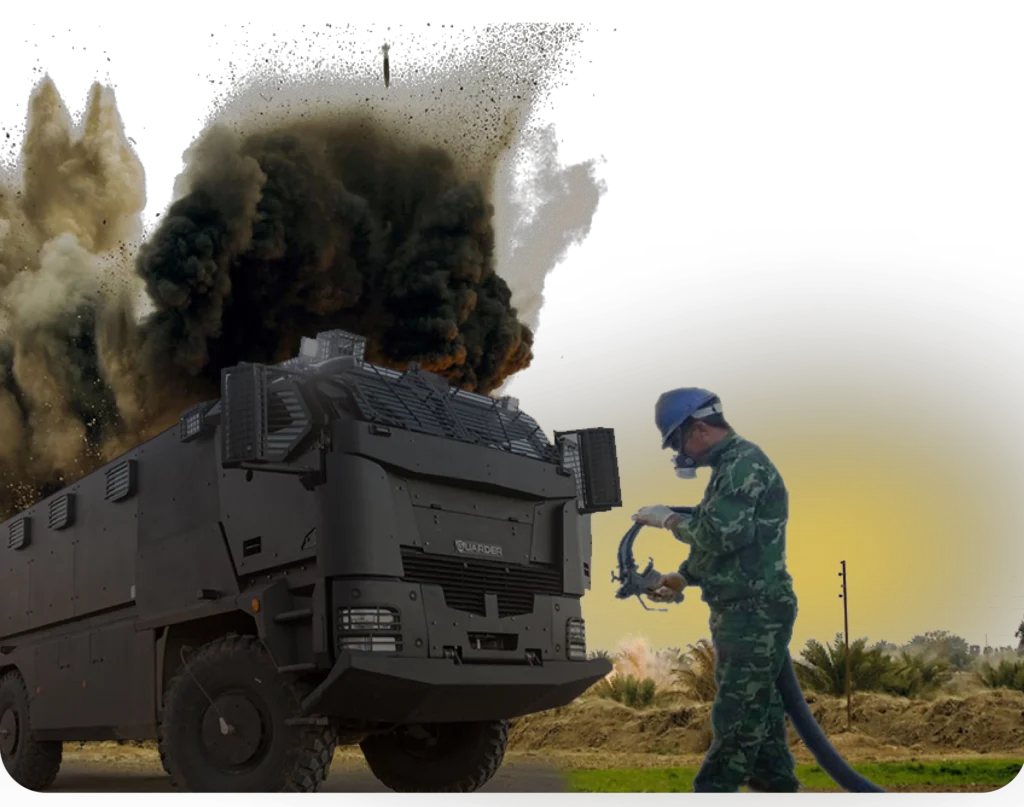 Polyurea Blast Protection in the Gulf Region: How ArmorThane Is Hardening Critical Infrastructure Across the Middle EastGulf region governments are turning to polyurea blast protection coatings to harden critical infrastructure. Learn how ArmorThane's proprietary UltraBlast and ArmorBlast systems…Read
 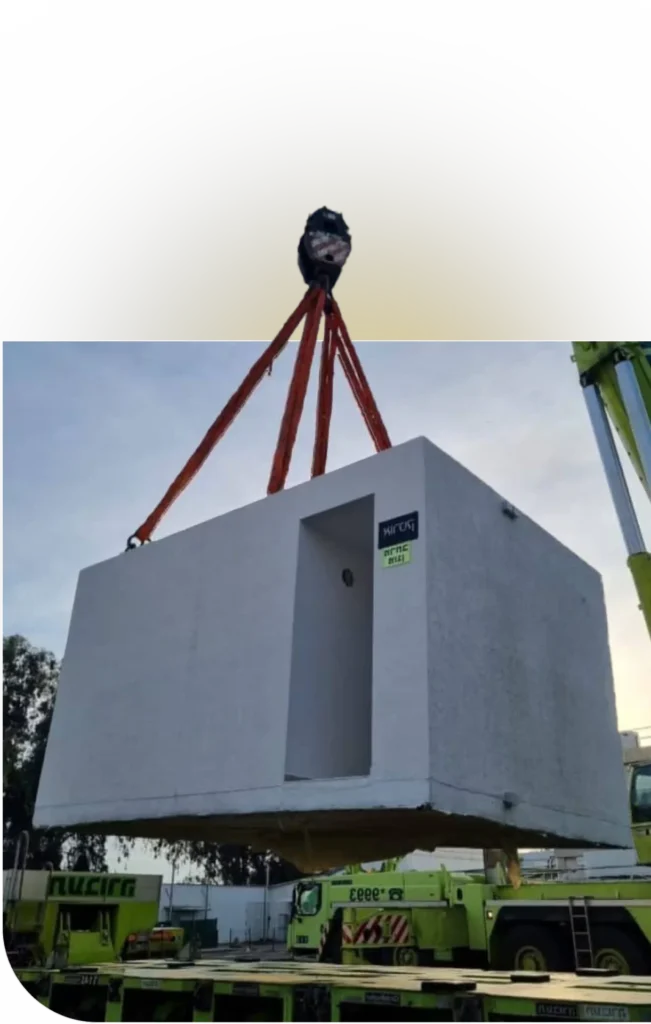 ArmorThane Secures Gulf Region Contracts to Supply Polyurea for Blast Mitigation ProjectsIn a landmark development for the global protective coatings industry, ArmorThane has secures contracts across multiple Gulf Cooperation Council (GCC) nations to…Read
  Enhancing Structural Defense in a High-Risk WorldIn a world where blast protection now factors into more building designs than ever before, the materials and systems chosen to protect…Read
Sources
- Davidson, J.S., Fisher, J.W., Hammons, M.I., Porter, J.R., Dinan, R.J. "Failure Mechanisms of Polymer-Reinforced Concrete Masonry Walls Subjected to Blast." Journal of Structural Engineering (ASCE) 131(8), 1194–1205, 2005. Tests by the Force Protection Branch, Air Force Research Laboratory, Tyndall AFB. DTIC ADA588077. View source
- Hoo Fatt, M.S., Ouyang, X., Dinan, R.J. "Blast Response of Walls Retrofitted With Elastomer Coatings." Structures Under Shock and Impact VIII, WIT Press, 2004. DTIC ADA589006. View source
- Somarathna, H.M.C.C., Raman, S.N., Mutalib, A.A., Badri, K.H. "Elastomeric Polymers for Blast and Ballistic Retrofitting of Structures." Jurnal Teknologi 76(1), 2015. View source
- UFC 4-010-01, DoD Minimum Antiterrorism Standards for Buildings, 12 December 2018, Change 3, 24 May 2024. Whole Building Design Guide. View source
- NAVSEA. "NSWC Carderock Division Scientist Receives Bowen Award" (U.S. Patent 7,300,893, Armor Including a Strain Rate Hardening Elastomer), 2015. View source
- Roland, C.M. "Soft Coatings for Armor Enhancement." DSIAC Journal, Winter 2018. View source
- Naval History and Heritage Command. "USS Cole (DDG 67)." View source
- U.S. Air Force. "20 years later: Remembering the attack on Khobar Towers," 2016. View source
- FBI Oklahoma City Field Office. "FBI Oklahoma City Field Office Observes 24th Anniversary of Oklahoma City Bombing," 2019. View source
- Jensen Hughes. "Explosion Control of Energy Storage Systems: Challenges & Opportunities," 2024. View source
- SAM.gov. "Entity Registration" and GSA guidance that registration in SAM.gov is always free. View source
- ArmorThane USA. "Opportunities: Becoming an Applicator" (published package pricing, training and dealer terms). View source
- ArmorThane USA. "ArmorThane Selected to Assist NATO for Blast Mitigation Testing." View source
- ArmorThane USA release via Spray Foam Magazine. "ArmorThane Lands Global Polyurea Blast Mitigation Contracts Across 8 Countries," April 23, 2026. View source
- APEX Accelerators (formerly Procurement Technical Assistance Centers), DoD Office of Small Business Programs. View source