On March 23, 2005, a vapor cloud ignited at the BP refinery in Texas City. Fifteen workers died, and every one of those deaths happened in or near trailers parked close to the unit for maintenance work. That accident is the reason blast resistant modular buildings are now a normal sight at refineries and chemical plants. This guide covers what a blast resistant module (BRM) is, how the ratings work, how API siting rules treat them, and what to check before you rent or buy one.
Why trailers stopped being acceptable
The U.S. Chemical Safety Board’s release on trailer damage at Texas City is sobering reading. The 15 fatalities happened in or near two trailers 121 to 136 feet from the blowdown drum. People were hurt in trailers as far as 479 feet away, and trailer damage showed up almost 1,000 feet out. At 597 feet, one trailer’s roof collapsed.
The CSB’s point was simple: overpressures that a modern blast-resistant control room would barely notice can flatten a light wood trailer. It issued an urgent recommendation to the American Petroleum Institute to write guidance on where occupied trailers and temporary buildings can go. That guidance became API RP 753.
What blast resistant modular buildings are
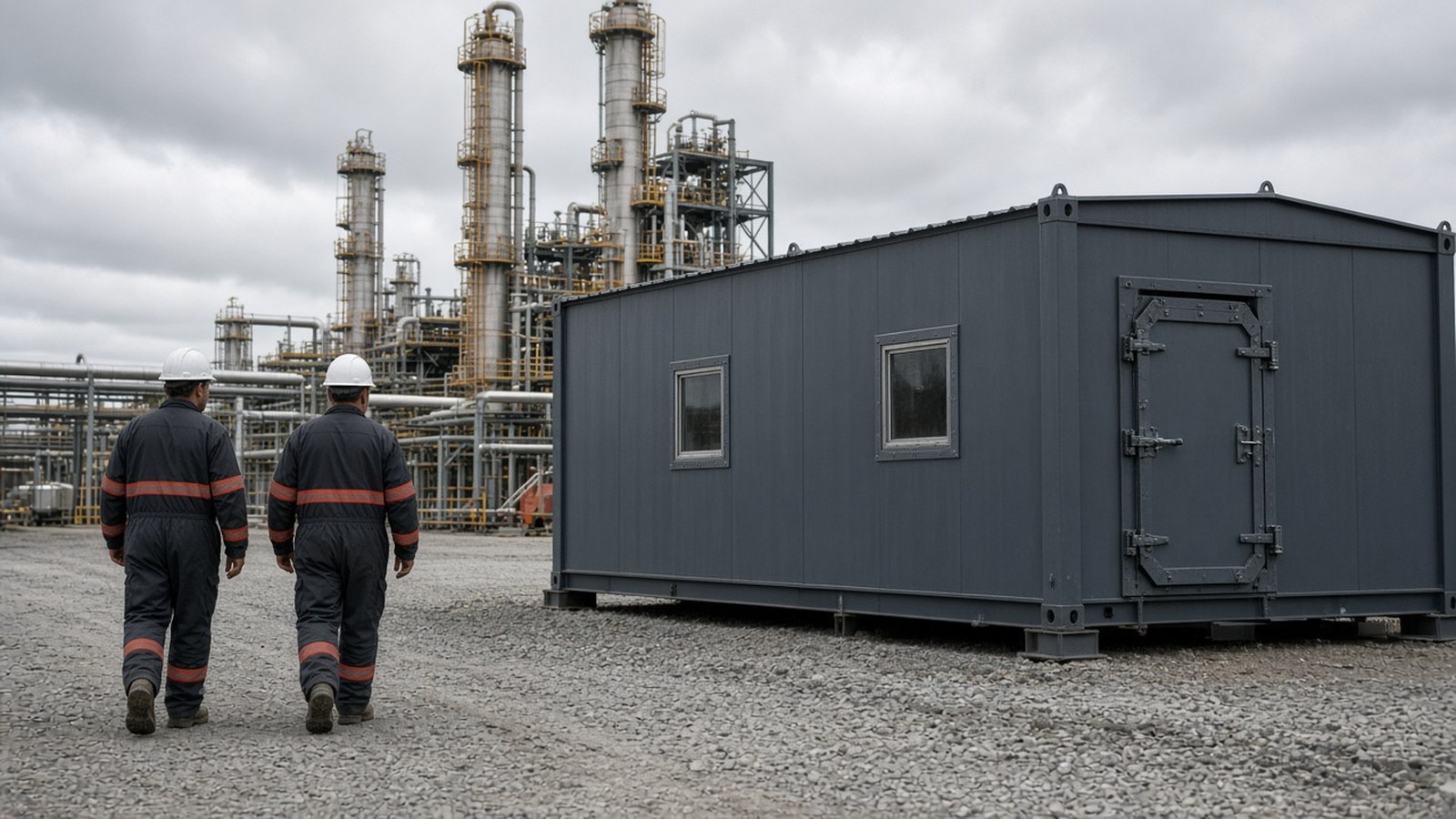
A BRM looks a lot like a shipping container or a steel office module, and some are built from container-style frames. The difference is in the engineering. Walls, roof, floor, doors, windows and anchorage are designed together to survive a specified blast load without collapsing or throwing debris at the people inside.
Typical features include:
- Heavy steel framing and steel wall panels designed to flex without breaking
- Blast-rated doors with heavy hinges and latches that open outward
- Few or no windows, and blast-rated glazing where they’re used
- Blast-rated wall penetrations for HVAC, power and data
- Interior finishes chosen so they don’t become projectiles
They’re used as operator shelters, turnaround offices, break rooms, control rooms, tool cribs, lab buildings and command posts.
How blast ratings work
You’ll see BRMs advertised with a rating like “8 psi at 200 ms.” Mobile Modular, for example, lists its blast resistant modules at 8.0 psi at 200 milliseconds with a low-to-medium response rating. Here’s what those three pieces mean.
| Term | What it means |
|---|---|
| Peak overpressure (psi) | How hard the blast wave pushes on the building |
| Duration (ms) | How long that push lasts; longer durations deliver more impulse |
| Response level (low, medium, high) | How much damage the building is allowed to take while still protecting occupants |
A rating is only meaningful against the blast your site could actually produce at that spot. A module rated 8 psi at 200 ms might be fine in one location and badly undersized 100 feet closer to a congested process unit. That’s why siting studies come first.
API RP 752, 753 and 756: which applies?
The three API recommended practices split buildings up by type. BakerRisk’s summary of the recent updates lays it out:
| Standard | Covers |
|---|---|
| API RP 752 | Permanent buildings, plus portable buildings (other than light wood trailers) intended to stay in one fixed location for the life of the building or plant |
| API RP 753 | Portable buildings intended to be moved, and all light wood trailers |
| API RP 756 | Tents |
So a BRM brought in for a turnaround falls under 753, while the same type of module set in place permanently may be treated under 752. The siting process is similar either way.
Zones, 0.6 psi, 0.9 psi and 330 feet
API RP 753 uses zones around process areas. In the BakerRisk summary, the Zone 1/2 boundary is the greater of 330 feet from the edge of a congested volume or the 0.9 psi overpressure contour. Zone 2 runs out to the 0.6 psi contour. Beyond that is Zone 3.
Those pressures are low. They’re based on what light wood trailers can take, not on what a BRM can take. In practice:
- Light wood trailers don’t belong in Zone 1.
- Other portable buildings, including BRMs, can be in Zone 1 only for essential personnel, and need an assessment.
- Anything in Zone 2 needs an assessment.
- Zone 3 doesn’t need an explosion assessment, though fire and toxic hazards still count.
Updated guidance also ties essential-personnel rules to a 330-foot distance from explosion and fire sources. The takeaway: a BRM isn’t a free pass to park non-essential people next to the unit.
Siting quick check
Portable building siting quick check (API RP 753 concepts)
Rent or buy: what to ask the supplier
BRM procurement checklist (click each)
☐ What exactly is the rating?
Get the peak pressure, duration and response level in writing, and the basis for them (testing, analysis or both).
☐ Does the rating match our siting study?
The module must handle the predicted load at the spot you’ll put it, not just a typical refinery number.
☐ How is it anchored?
A strong box that slides or overturns isn’t protective. Anchorage is part of the design.
☐ Doors and windows
Are they rated to the same level as the walls? They’re common weak points.
☐ Penetrations
HVAC, power and data entries need to keep the rating intact.
☐ Interior fit-out
Lights, ceiling panels, cabinets and equipment need to stay put during a blast.
☐ Fire and toxic protection
Ask about fire rating, gas detection and HVAC shutdown if those hazards apply.
Turnarounds are when the risk spikes
Most of the year, a plant has a fairly steady population. Then a turnaround starts and hundreds of contractors show up, along with offices, break rooms, tool cribs and lunch tents. Everybody wants to be close to the work, because walking a quarter mile each way eats into the shift. That’s exactly the pressure that put trailers next to the isomerization unit at Texas City.
A few habits help:
- Do the siting study for temporary buildings before the turnaround, not the week it starts.
- Keep a live map of where every portable building is and who is in it.
- Treat moving a building as a management-of-change item, even if it’s “just 50 feet.”
- Put break rooms and offices out in Zone 3 where you can, and use BRMs for the people who truly have to be close.
- Remember that during startup and shutdown, the hazard picture changes. Some of the worst accidents happen then.
Keeping a module’s rating over the years
A BRM that’s been rented out for a decade isn’t automatically as strong as the day it was built. Doors get forced, hinges wear, anchors go missing and somebody cuts a new hole for a window unit. Corrosion eats at base rails and floor framing in Gulf Coast humidity.
Ask for inspection records on a used or rented module. Look at door hardware, seals, anchor points, wall penetrations and the steel at the base. Any modification should be reviewed by the manufacturer or an engineer, since a new opening can undo the rating.
Keeping the inside safe
A module can survive the blast and still hurt people if the interior turns into shrapnel. Monitors fall, ceiling tiles drop, cabinets tip and loose gear flies. Good practice is boring and effective: secure equipment, use light fixtures and ceilings designed for the rating, keep clutter down and don’t hang heavy things overhead.
Glass is the other big injury source. If the module has windows, they should be rated with the rest of the building. Our guide to blast resistant windows explains glazing, film and catch systems.
Where coatings fit
BRMs are steel structures, and the blast resistance comes from the structural design, not paint. Coatings still matter. A durable coating system protects the steel from corrosion in salty, humid plant air, which protects the rating over years of service. In permanent buildings, sprayed polyurea is also used as a retrofit layer on walls to reduce fragmentation; we explain how in blast resistant walls. If you’re weighing protection for columns and piers on the same site, see catch coatings vs wrap systems.
Blast resistant modular buildings FAQ
What is a blast resistant modular building?
A portable or modular steel building designed and rated to protect occupants from a specified explosion overpressure and duration.
What does 8 psi at 200 ms mean?
The building is rated for a blast wave with 8 psi peak overpressure lasting 200 milliseconds, at a stated damage response level.
Which API standard covers blast resistant modules?
Movable portable buildings fall under API RP 753. Modules installed permanently in one location may be assessed under API RP 752.
Can non-essential personnel use a BRM near a process unit?
Under API RP 753, portable buildings in Zone 1 are limited to essential personnel, and the location needs an assessment.
Do blast resistant modules need a siting study?
Yes, unless they’re in Zone 3. The rating has to be checked against the predicted blast load at the actual location.